The NFL news cycle was thrown into turmoil today as reports began circulating that the mother of Rashee Rice was allegedly arrested for a second time, with an arrest photo reportedly released in connection to a mail theft case, all while Rice himself remains at the center of an intense and unresolved domestic violence controversy that has already shaken public trust and divided fans across the league.
The timing of these developments has amplified the reaction far beyond a typical off-field headline. For many observers, the combination of a family-related legal issue and an ongoing personal scandal involving an active NFL player has created a narrative that feels heavy, uncomfortable, and impossible to ignore, especially in an era where every detail spreads instantly across social media.
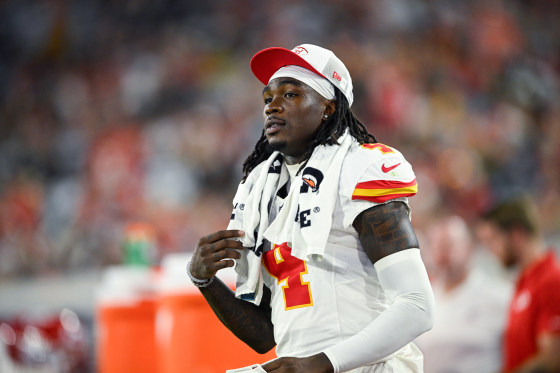
According to circulating reports, the alleged arrest involves accusations tied to stolen mail, a charge that often sparks strong reactions due to its implications around privacy and federal offenses.
While official details remain limited and legal proceedings have not fully played out, the release of an arrest image alone was enough to ignite a storm of speculation, commentary, and moral judgment online.
At the same time, Rashee Rice’s own situation has already placed him under intense scrutiny. The domestic violence allegations involving the young wide receiver have been described by sources as serious and emotionally charged, with fans and analysts waiting for clarity from law enforcement, the league, and Rice himself. No final legal outcome has been reached, but the uncertainty has left a vacuum that public opinion has rushed to fill.

What makes this moment especially volatile is how quickly narratives become intertwined. For many on social media, the reported arrest of Rice’s mother was immediately framed as part of a larger story about character, upbringing, and accountability, despite repeated reminders from legal experts that individuals are not responsible for the alleged actions of family members. That distinction, however, often gets lost in the speed and emotion of online discourse.
Some fans have pushed back hard against what they see as irresponsible piling-on. They argue that dragging a player’s family into an already sensitive situation crosses a line and risks turning legal processes into public entertainment.

Others counter that when a player is already facing serious allegations, any related news becomes relevant in shaping how the public perceives the overall situation.
Inside NFL circles, this kind of controversy is viewed as particularly damaging because it blurs boundaries between professional evaluation and personal judgment.
Teams, sponsors, and league officials are forced to monitor not just on-field performance but the broader narrative surrounding a player, even when parts of that narrative involve alleged actions by people outside the organization.

The league itself has remained publicly cautious. Historically, the National Football League has emphasized due process, often waiting for legal clarity before issuing discipline or formal statements.
Still, critics argue that silence can feel like avoidance, especially when fans are already emotionally invested and demanding answers.
From a social media perspective, this story has all the ingredients of viral controversy. Screenshots, headlines, and reaction videos have spread rapidly, often without context or verification.
In many cases, the nuance of “alleged” disappears entirely, replaced by certainty that may not reflect legal reality. That pattern has raised concerns among journalists and legal analysts about long-term reputational damage.
For Rashee Rice, the pressure is now layered and relentless. Even as he has not been legally convicted of any wrongdoing, the combination of personal allegations and family-related reports has created a narrative that threatens to overshadow his football career.
Fans who once debated his route running and game impact are now debating ethics, responsibility, and consequences.
There is also a broader conversation emerging about fairness and boundaries. Should the alleged actions of a player’s family influence how that player is treated by the public or the league.

Many argue that doing so reinforces harmful assumptions and distracts from the facts of individual cases. Others believe that public figures inevitably face expanded scrutiny, whether fair or not.
In locker rooms across the league, situations like this are often viewed with quiet unease. Players understand how quickly life can spiral once a narrative takes hold, and how difficult it is to regain control once public opinion hardens.
Several former players have spoken in the past about the toll of being judged not just for their own actions, but for everything connected to their name.
The legal process will ultimately determine the facts surrounding both the alleged arrest and the domestic violence case. Until then, speculation will continue to fill the gaps.
That reality has become one of the defining challenges of modern sports culture, where the demand for instant answers collides with the slow, deliberate pace of justice.
For fans, this moment forces uncomfortable reflection. Supporting a team or player now often means navigating moral ambiguity, incomplete information, and emotional reactions that extend far beyond the field.
Some will choose to wait for facts. Others will make up their minds immediately, guided by personal values or past experiences.
As this story develops, its impact may extend well beyond one player or one family. It highlights how quickly private lives can become public battlegrounds, and how easily complex legal situations are reduced to shareable outrage.
The consequences of that shift are still unfolding, not just for Rashee Rice, but for how the NFL and its audience handle controversy in the years ahead.
In the end, this is no longer just a football story. It is a reflection of how fame, family, and accusation intersect in the digital age, where patience is rare and judgment is instant.
Whether clarity brings resolution or further division remains to be seen, but the conversation ignited by these reports is unlikely to fade anytime soon.