
“Come On, You Big Dummy!” — The Moment Cheryl Miller Forced Women’s Basketball to Confront Its Own Double Standards
Women’s basketball has always evolved in waves — generational talents, cultural shifts, rule changes, and moments of truth that expose what the sport really believes about itself. Most of those moments arrive quietly, wrapped in statistics or buried in postgame quotes. This one didn’t.
It came loud. It came blunt. And it came from someone whose voice still carries the weight of history.
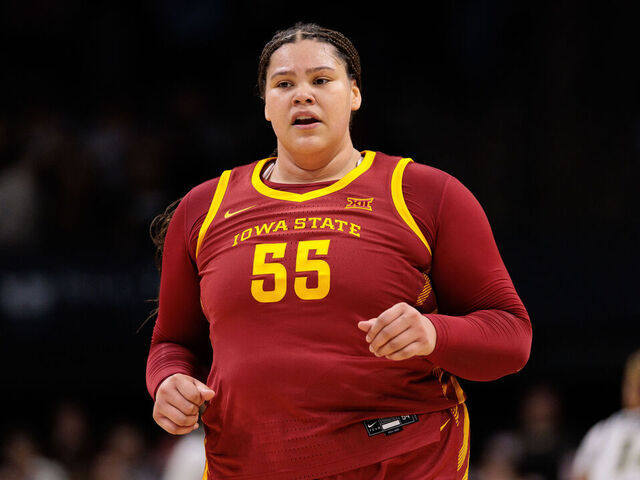
When Cheryl Miller, one of the most revered figures the game has ever produced, delivered her now-viral rebuke — “Come on, you big dummy!” — it wasn’t just a sound bite. It was a line drawn in public, a refusal to keep playing along with narratives that have followed women’s basketball for far too long. And at the center of that confrontation stood Iowa State phenom Audi Crooks, whether she asked for it or not.
This wasn’t about attacking a player. It wasn’t even about defending one. It was about calling out a system that praises certain kinds of greatness while quietly questioning others — and pretending that scrutiny is the same as fairness.
For years, women’s basketball has celebrated its growth while avoiding uncomfortable conversations about how players are framed, marketed, and judged. Cheryl Miller didn’t avoid it. She kicked the door open.
Audi Crooks is not controversial because of how she plays. She is controversial because of how people talk about how she plays.
A dominant post presence with elite footwork, touch, and basketball IQ, Crooks has been described with language that feels suspiciously outdated — “old-school,” “limited,” “not built for the modern game.” These phrases are often presented as neutral analysis. Miller’s outburst suggested otherwise.
What she exposed was the hypocrisy at the heart of the discourse: men’s basketball still celebrates dominant bigs as anchors, forces, and matchup nightmares, while women’s basketball often treats similar dominance as a problem to be solved.
Miller’s frustration wasn’t subtle. It carried the exhaustion of someone who has seen this movie before — watched generations of women get boxed into narratives that have less to do with basketball and more to do with comfort. Comfort for analysts. Comfort for fans. Comfort for a sport trying to appear progressive while clinging to narrow definitions of what star power should look like.
The real sting of Miller’s words wasn’t the insult. It was the implication behind it: that the conversation itself had become lazy.
Lazy takes are the quiet enemy of growth. They repeat themselves until they sound like truth. They label players instead of studying them. They reduce complex skill sets into caricatures — shooter, defender, post, tweener — and then punish athletes who don’t fit neatly into whatever the current trend demands.
Audi Crooks doesn’t need to apologize for being effective in the paint. She doesn’t need to stretch her game for aesthetics. She doesn’t need to become a different player to validate someone else’s idea of “modern.”
That was Miller’s point.
Women’s basketball has spent years asking for respect, visibility, and serious analysis. But serious analysis requires effort — film study, context, historical awareness. It demands acknowledging that dominance can look different and still be legitimate.
Instead, too often, the conversation defaults to comparison traps. Who does she look like? Who would she struggle against? Would this work at the next level? These questions aren’t inherently wrong. But when they are asked disproportionately of certain players — particularly post players — they reveal bias dressed up as concern.
Miller’s comments landed because they disrupted that pattern. They reminded people that the game doesn’t owe anyone a specific aesthetic. The job of a basketball player is to win possessions, create advantages, and punish mismatches. Crooks does all three at a high level.
The irony is that the same voices questioning her “fit” are often the ones celebrating efficiency, physicality, and IQ when those traits appear elsewhere. Miller called out that contradiction with the bluntness of someone who no longer feels obligated to soften the message.
And that bluntness matters.
Legends don’t speak often, but when they do, it’s usually because silence has become more uncomfortable than backlash. Miller has lived through eras where women were told to be grateful for attention, not critical of it. Her refusal to play that role anymore is part of why this moment feels different.
It signals a shift — not just in tone, but in permission.
Permission for analysts to do better work. Permission for fans to question narratives they’ve accepted without realizing it. Permission for players like Crooks to exist without constantly being framed as exceptions.
This reckoning isn’t about one comment or one player. It’s about whether women’s basketball is ready to mature past surface-level storytelling and into something more honest.
Growth doesn’t just come from viral highlights or packed arenas. It comes from how a sport talks about itself when no one is forcing it to perform. It comes from whether dominant players are celebrated for what they do, not critiqued for what they don’t resemble.
Cheryl Miller didn’t change the conversation by being polite. She changed it by being precise. By refusing to let coded language go unchecked. By reminding everyone that basketball excellence has never had a single template.
Audi Crooks will keep playing. She will keep scoring. She will keep forcing defenses to adapt. What happens next isn’t about her performance — it’s about whether the sport listening to Cheryl Miller is ready to evolve with the same courage it demands from its players.
Because once a legend says the quiet part out loud, there’s no pretending the mirror isn’t there anymore.